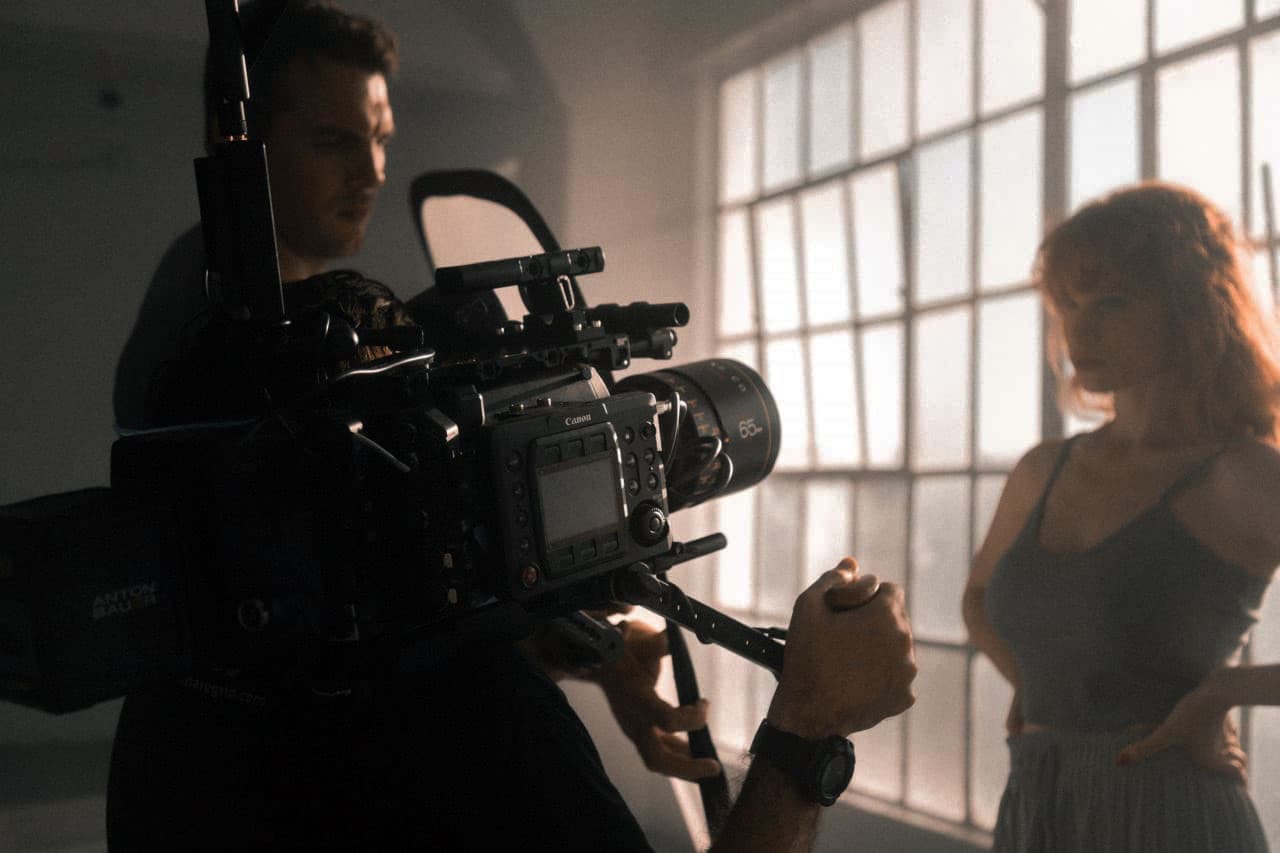
In the theater, an actor works from a distance. Even if the audience is sitting in the front row, there remains a physical and psychological distance between the stage and the auditorium. In film, this distance doesn’t exist. The camera can get closer than any live audience member ever could: to the eyes, to the lips, to the barely perceptible tension in the jaw. And that’s precisely why film demands a different kind of acting. Not restrained, but precise. Not grandiose, but concentrated.
From stage to frame
The transition from theater to film is often painful precisely because the familiar stage tools begin to work against the actor. Where the stage forgives generalizations, the camera records everything. Where a gesture was expressive, it becomes intrusive. Where emotion was “played out” in the body, it becomes illustration. Film doesn’t enhance performance—it exposes it.

Editing and Takes
Another fundamental difference between film and theater is their fragmented nature. A stage role is lived from beginning to end in a single flow, whereas film acting is almost always broken into fragments: different shots, angles, takes, and non-chronological filming. The actor must maintain their internal state not linearly, but point by point—entering the emotion “from the spot,” sometimes hours after the previous shot.
This requires special concentration and body memory. It’s important to remember not only what the character is feeling, but also what level of intensity they are at at that particular moment in the scene. Editing will then connect these fragments into a coherent whole, and any excess emotion or shift in state will become noticeable. Therefore, in film, the ability to precisely dose internal tension and maintain it from take to take, without intensifying or “playing for the result,” is valued.
Breathing, Gaze, and Inner Rhythm
In theater, breathing is an instrument that supports the voice, tempo, and overall dynamics of the scene. In film, it becomes a mirror of the actor’s inner state. Overly even breathing during tense moments, a predictable inhalation before a line, or a deliberate theatrical pause—the camera detects all of this as unnatural, creating a feeling of falseness in the viewer, even if the cause is unconscious.
Similarly, the gaze on stage is often directed and addressed (to the partner, the audience, the space). In film, the gaze takes on an intimate quality. It can be vague, directed away or “past” the interlocutor, but it must still be filled with thought. The camera does not demand external expression from the eyes; it captures the inner life. If thought is present, the gaze will find its natural expression.
Inner rhythm in film also differs from that of the stage. Theatrical expressiveness allows for the use of emphasized pauses and rhythmic accents. In film, however, an overly constructed rhythm quickly becomes affected. Often, the most truthful reaction is not the one dictated by the dramaturgy, but the one that appears with some delay, doubt or internal resistance.
Why cinema requires depth
The assertion that film requires “less acting” is misleading. On the contrary, film demands greater depth of experience from the actor. External manifestations (gestures, intonations) fade into the background, giving way to the inner state. The camera doesn’t exaggerate; it reveals true emotions. If the inner state is empty, no external devices can save the scene.
Film is particularly sensitive to pauses. Silence in the frame is not filled with external form, but becomes an independent element. The actor cannot be distracted by the action; he is forced to remain alone with his inner processes. Therefore, true film acting often seems unfinished, not brought to a vibrant conclusion, yet very lively. To understand the difference between stage and screen acting, it is useful to focus on the key differences in the transition from stage to camera:
- Reducing the range of motion and avoiding exaggerated gestures
- Focusing on breathing as a reaction, not as a technique
- Prioritizing internal impulse over external action
- Working with the gaze as a thought process, not an expressive device
Theater teaches you to maintain form and space. Cinema teaches you to withstand intimacy and silence. The camera gets too close to allow for the actor’s usual defensiveness. It’s not interested in how well you play the role—it’s interested in what’s happening to you in that moment.
When habitual expressiveness begins to interfere
Stage acting is built on magnification: gestures, intonation, and body movements must be readable from the back rows, even in a chamber theater. The camera perceives any magnification as excessive. What appeared clear and composed on stage begins to seem ostentatious or unnatural in the frame.
In film, the camera sees not the form of movement, but its cause. It captures the tension in the shoulders, the clenched jaw, the unconscious shift in weight. Any “made” movement is immediately interpreted as the actor’s intention, not the character’s reaction. Therefore, many directors ask the actor to do literally nothing in the frame: the less external activity, the more space there is for the internal process.
For an actor, this is a difficult transition. They must abandon the habit of “showing” and allow the camera to observe. Here, things that cannot be precisely controlled are especially important—micropauses, spontaneous reactions, imperfect transitions between states. Cinema values not beautiful form, but the sensation of a living body in a specific situation.