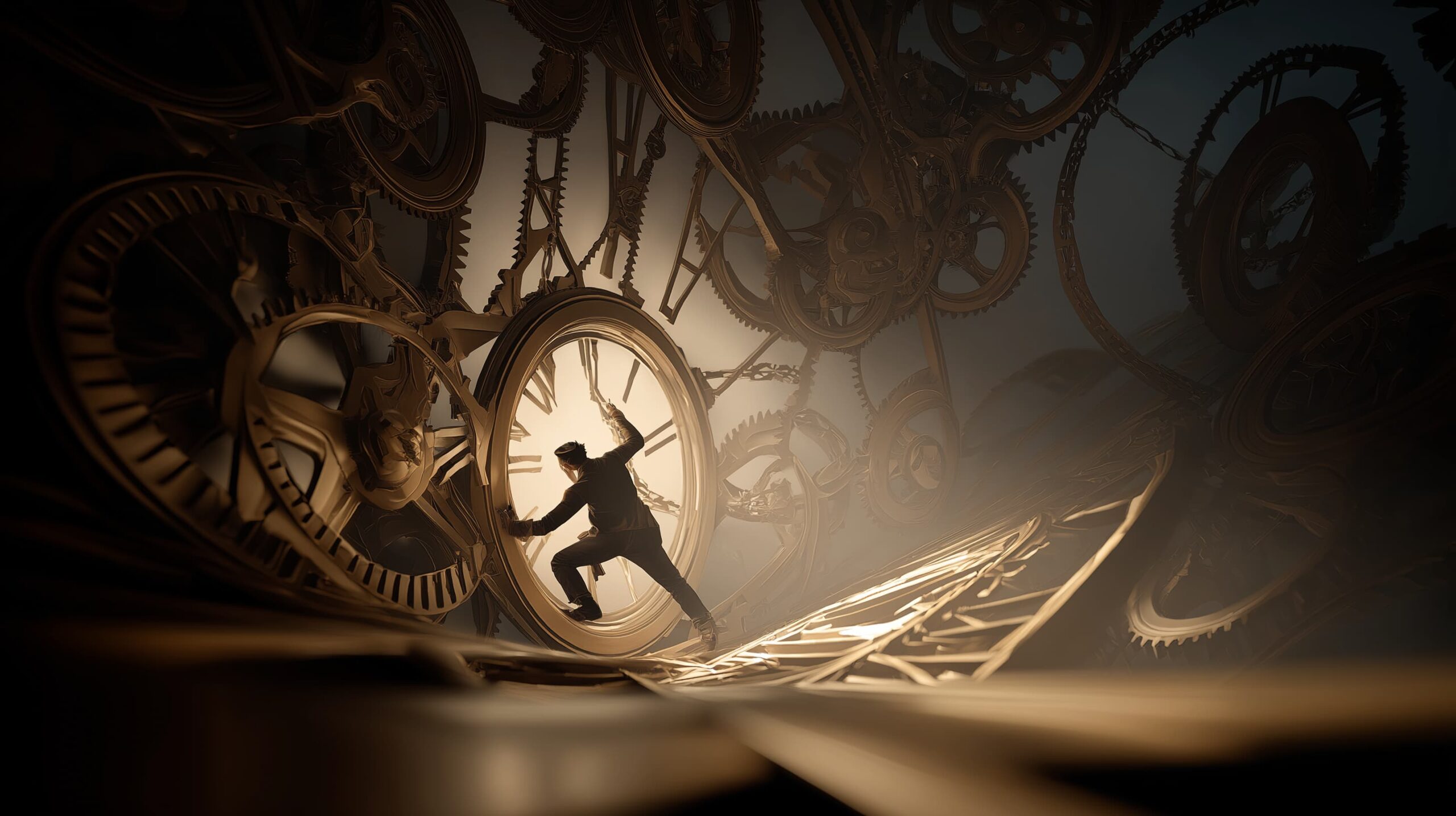
Time is one of the most invisible yet powerful elements of cinema. For audiences, a film unfolds as a seamless flow of events, carefully edited to create rhythm, tension, and emotional progression. Viewers experience time as narrative – compressed, expanded, or rearranged according to the logic of storytelling. For actors, however, time operates very differently. Their experience of time is fragmented, elastic, and often psychologically complex, shaped not by the finished story but by the realities of performance and production.
Understanding this contrast reveals something fundamental about the nature of acting and the mechanics of film itself.
For audiences, cinematic time is largely an illusion. Editing, music, and narrative structure guide perception. A two-hour film may represent decades of fictional events, while a single dramatic moment can be extended far beyond real-time duration. Spectators rarely notice this manipulation because the brain willingly accepts the continuity of the story. Emotional engagement sustains the illusion, allowing viewers to feel immersed in a coherent temporal world.
Actors, by contrast, inhabit a completely different temporal framework. They do not experience the story linearly. Scenes are typically shot out of sequence, often dictated by logistical concerns rather than narrative order. An actor may perform the emotional climax of a story before filming its opening moments, then move to unrelated segments days or weeks later. The character’s psychological timeline must therefore be constructed internally, independent of the shooting schedule.
This disjunction produces a distinctive perception of time. Instead of flowing naturally, time becomes discontinuous. Actors must mentally navigate between different emotional states, sometimes within the same day. One morning might involve a lighthearted early-scene interaction; the afternoon may demand intense grief or confrontation. Temporal continuity, which audiences take for granted, becomes an intellectual and emotional task for the performer.
The challenge is not merely technical but deeply psychological. Human emotions are ordinarily experienced as responses to unfolding circumstances. In filmmaking, actors often recreate these responses without the benefit of chronological buildup. They must summon emotional intensity detached from natural temporal progression. This process requires imaginative reconstruction of the character’s past and future – a mental simulation of experiences that the actor has not yet performed or may have already completed.
Repetition further complicates the actor’s experience of time. A single scene may be filmed multiple times from different angles, distances, and technical setups. What audiences later perceive as a brief, spontaneous moment might represent hours of repeated performance. Each take demands consistency, precision, and emotional authenticity, even as the actor becomes increasingly aware of the artificiality of the situation.
For viewers, time in film is condensed. For actors, it is often stretched.
This stretching alters subjective perception. Repeating the same lines and gestures can produce a sense of temporal suspension, where the dramatic “moment” no longer aligns with lived experience. The performer must preserve freshness and emotional credibility despite mechanical repetition. Maintaining the illusion of immediacy under such conditions is one of the least visible yet most demanding aspects of screen acting.
Physical production rhythms also shape temporal awareness. Film sets operate according to technical priorities – lighting adjustments, camera repositioning, sound checks, and scheduling constraints. Actors spend significant periods waiting between performances, sometimes for hours. The alternation between intense emotional engagement and prolonged inactivity creates a unique temporal pattern rarely encountered in everyday life.
From the audience’s perspective, a character appears to exist continuously within the narrative world. From the actor’s perspective, that existence is intermittent, punctuated by pauses and resets. The character lives only during the moments of performance; between takes, the illusion dissolves into practical reality.
Memory plays a central role in bridging these temporal gaps. Actors rely on a form of constructed memory, retaining precise emotional and psychological details across discontinuous shoots. They must remember not only lines and blocking but also the character’s evolving internal state. What has the character just experienced? What knowledge do they possess at this point in the story? How should prior events influence present behavior?
These questions reflect a temporal logic distinct from that of spectatorship. Audiences experience the story passively as it unfolds. Actors actively maintain temporal coherence, constantly recalibrating their performance to align with an imagined chronology.
Another key difference lies in emotional duration. For viewers, emotions arise and dissipate according to narrative flow. A dramatic revelation may feel intense yet brief, embedded within the film’s overall rhythm. For actors, emotional states may need to be sustained or repeatedly accessed over extended periods. The emotional “moment” is no longer momentary; it becomes a recurring requirement shaped by production demands.
This divergence influences how performers understand dramatic time. Actors often develop heightened sensitivity to micro-temporal elements – pauses, reaction timing, shifts in attention – because these details affect both performance and editing. A fraction of a second can alter the emotional meaning of a scene. What audiences later perceive intuitively is often the product of meticulous temporal control.
Interestingly, the camera introduces yet another layer of temporal complexity. Film acting operates within a frame that magnifies subtlety. Small gestures, brief glances, or minimal delays acquire amplified significance. Actors must therefore calibrate their timing with extraordinary precision, aware that cinematic time will transform tiny intervals into emotionally charged signals.
For audiences, time is consumed. For actors, time is engineered.
Despite these differences, both experiences ultimately converge in the finished film. Editing synthesizes fragmented performances into continuous narrative flow. Hours of repetition collapse into seconds of screen time. Discontinuous shooting becomes invisible. The audience encounters a temporal reality fundamentally different from the one lived by the performers.
This contrast underscores the collaborative nature of cinema. Acting is not merely the embodiment of character but the navigation of complex temporal structures. Performers operate within multiple layers of time: production time, character time, and eventual screen time. Mastery involves reconciling these layers into behavior that feels natural and immediate.
The disparity between actor and audience perceptions of time reveals the remarkable artifice underlying cinematic realism. What appears fluid and spontaneous is often constructed through discontinuity, repetition, and deliberate temporal design. Viewers experience the illusion of continuous life; actors inhabit a mosaic of moments assembled into coherence.
In this sense, cinema transforms time twice. First, through the actor’s imaginative reconstruction of the character’s timeline. Second, through editing, which reshapes performance into narrative rhythm. The result is a shared temporal experience that masks the radically different ways in which time was originally lived.
Recognizing this difference deepens appreciation for screen performance. It highlights the invisible labor behind emotional continuity and the unique cognitive demands of acting for film. Most importantly, it reminds us that cinematic time – so effortlessly absorbed by audiences – is, for actors, a carefully navigated landscape of fragments, repetitions, and creative reconstruction.